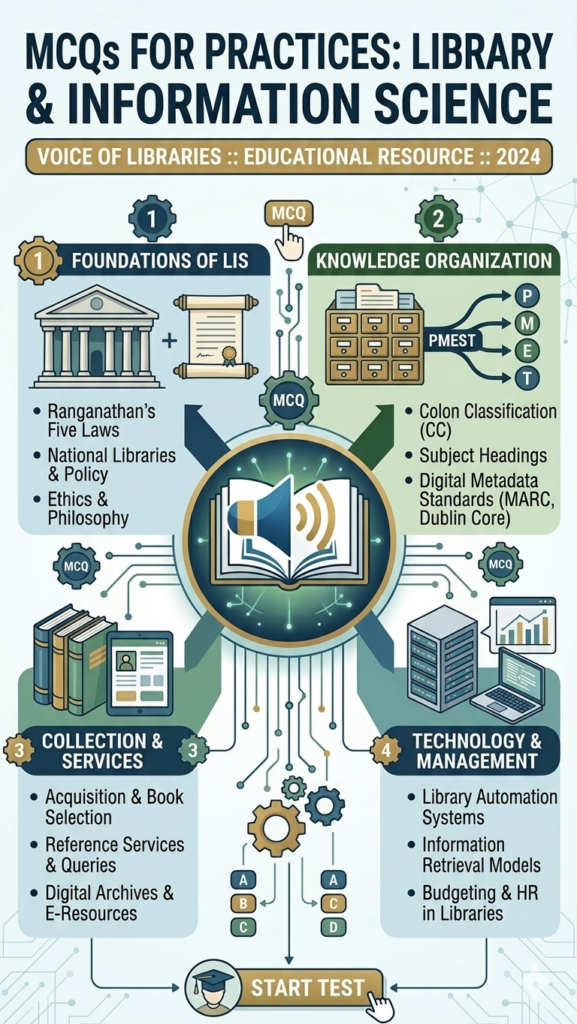
MCQs for Exam Preparation

Your Ultimate Guide for LIS Exam Preparation

At Voice of Libraries, we provide comprehensive resources for students and professionals preparing for all types of Library and Information Science (LIS) exams. Whether you are gearing up for FPSC, PPSC, SPSC, BPSC, KPSC, AJKPSC, NTS, PTS, or any other government or private job tests, our platform is here to help. We offer expertly crafted MCQs, study materials, and exam tips tailored to meet the demands of these exams.

Our website is one of Pakistan’s leading platforms dedicated to LIS job preparation, designed to help you achieve your career goals in the field of Library and Information Science. From study resources to the latest job updates, we ensure that our users are always one step ahead.

Explore our website and prepare confidently with Voice of Libraries!

found a lot of mcqs for PPSC, FPSC, KPSC, SPSC, BPSC, AJKSC, NTS, PTS, for Librarian, Assistant Librarian, Catalogure, Classifire, Director, etc

COMPETITIVE LIS EXAM RESOURCES

Thousands of MCQS for Test preparation

MCQs for ALL LIS Exam FPSC, PPSC, SPSC, BBSC, KPPSC, AJ-KPSC, NTS, PTS

Category: MCQS for Practices

Test No. 1 || Trade Literature (Library Information Science)

📘 20 MCQs on Trade Literature (with Answers)

1 / 20

4. Trade literature is considered a:

2 / 20

3. Which of the following is a common form of trade literature?

3 / 20

2. The main purpose of trade literature is to:

4 / 20

1. Trade literature is primarily published by:

5 / 20

9. Trade literature is often available:

6 / 20

8. Which library uses trade literature the most?

7 / 20

7. Trade journals are issued by:

8 / 20

6. Trade literature often provides:

9 / 20

5. Which item is NOT included in trade literature?

10 / 20

10. A document explaining how to operate a machine is called:

11 / 20

11. Trade literature helps researchers by providing:

12 / 20

12. Which filing system is mostly used to organize trade literature in libraries?

13 / 20

13. Outdated trade literature should be removed through:

14 / 20

14. Trade catalogues mainly contain:

15 / 20

15. Which of the following is a characteristic of trade literature?

16 / 20

16. Trade literature is important for libraries because it:

17 / 20

17. Product price lists are part of:

18 / 20

18. Which library service is supported by trade literature?

19 / 20

19. Trade literature is MOST relevant for students of:

20 / 20

20. Trade literature can sometimes be the only source for:

Your score is

The average score is 11%

0%

Test No. 3 || Research Monograph (Library Information Science)

20 Most Important MCQs for FPSC, PPSC and Other Commission with answer

1 / 20

1. A research monograph is mainly focused on:

2 / 20

2. The word “Monograph” is derived from which language?

3 / 20

3. “Monos” in Greek means:

4 / 20

4. A research monograph is usually based on:

5 / 20

5. A research monograph is considered a:

6 / 20

6. Which of the following best describes the scope of a research monograph?

7 / 20

7. A research monograph is generally published as:

8 / 20

8. The usual length of a research monograph is about:

9 / 20

9. Which section of a monograph discusses previous studies?

10 / 20

10. Which part explains the research methods used in a monograph?

11 / 20

11. A research monograph is most useful for:

12 / 20

12. Which of the following is NOT a feature of a research monograph?

13 / 20

13. In libraries, research monographs are usually placed in:

14 / 20

14. Which academic level mostly uses research monographs?

15 / 20

15. A research monograph contributes mainly to:

16 / 20

16. Which element comes at the end of a research monograph?

17 / 20

17. A research monograph differs from a textbook because it:

18 / 20

18. Who usually writes a research monograph?

19 / 20

19. The main purpose of a research monograph is to:

20 / 20

20. In Library Science, research monographs are important because they:

Your score is

The average score is 52%

0%

Test No. 2 || Patents — Legal Protection for Inventions (Library Information Science)

20 MCQs for PPSC & FPSC (with Answers)

1 / 20

20. One major benefit of patents for society is:

2 / 20

19. “Patent Specification” refers to:

3 / 20

18. Patents contain which type of information?

4 / 20

17. In library science, patents are classified as:

5 / 20

16. Which of these is a NEED for patents?

6 / 20

15. A patent is usually granted after:

7 / 20

14. When a patent expires, the invention becomes:

8 / 20

13. Patents are part of which larger system?

9 / 20

12. Which of the following is a function of patents?

10 / 20

11. Patents are important for industries because they:

11 / 20

10. Which is the main requirement for an invention to be patented?

12 / 20

9. The document issued by the government for a patent is called:

13 / 20

8. A patent provides rights to:

14 / 20

7. Which body typically grants patents?

15 / 20

6. The word “Patent” originates from a Latin term meaning:

16 / 20

5. The usual duration of a patent is:

17 / 20

4. Which of the following is not patentable?

18 / 20

3. The primary purpose of a patent is to:

19 / 20

2. Patents legally protect:

20 / 20

1. What is a patent?

Your score is

The average score is 70%

0%

Test No. 4 || Mastering Monographs: 20 Solved MCQs for MLIS, M.Phil & PPSC/FPSC Exams

1 / 25

Which of the following describes a “Series” in relation to monographs?

2 / 25

An “Electronic Monograph” is another term for:

3 / 25

The “Chief Source of Information” for cataloging a printed monograph is the:

4 / 25

Which MARC field is used for the ‘Edition Statement’ of a monograph?

5 / 25

What is a “Festschrift” usually considered in library processing?

6 / 25

In the DDC system, monographs are primarily organized on shelves by:

7 / 25

Which of the following is NOT typically a monograph?

8 / 25

In RDA, the “Statement of Responsibility” for a monograph is found in which MARC field?

9 / 25

A PhD thesis that is published as a standalone book is classified as a:

10 / 25

When a library buys a monograph, the transaction is typically referred to as a:

11 / 25

Which MARC field is used to record the ISBN of a monograph?

12 / 25

The term “Monograph” is derived from the Greek words ‘monos’ and ‘grapheine’, which mean:

13 / 25

In cataloging, the ‘Main Entry’ for a monograph is most commonly:

14 / 25

Which bibliographic standard has largely replaced AACR-2 for the description of monographs?

15 / 25

In the MARC 21 Fixed-Length Data Elements (Field 008), which code represents a “monograph” in the ‘Type of Record’ position?

16 / 25

A multi-volume monograph differs from a serial because:

17 / 25

In MARC 21 format, which field is used for the Physical Description of a monograph?

18 / 25

In cataloging, the ‘Main Entry’ for a monograph is most commonly:

19 / 25

Which bibliographic standard has largely replaced AACR-2 for the description of monographs?

20 / 25

In the MARC 21 Fixed-Length Data Elements (Field 008), which code represents a “monograph” in the ‘Type of Record’ position?

21 / 25

A multi-volume monograph differs from a serial because:

22 / 25

In MARC 21 format, which field is used for the Physical Description of a monograph?

23 / 25

According to AACR-2R, a monograph is a publication that is:

24 / 25

Which of the following standards is primarily used for the unique identification of monographs?

25 / 25

In the context of library science, what is the defining characteristic of a monograph?

Your score is

The average score is 44%

0%

Test No. 5 || Accessioning & Records : Library Science Practice Quiz

1 / 15

Which of the following is the standard sequence for processing a new book?

2 / 15

Who is responsible for the accuracy of the Accession Register?

3 / 15

In the “Remarks” column of an Accession Register, what is typically recorded?

4 / 15

The width of a standard physical Accession Register is usually:

5 / 15

Which document acts as the legal proof of the library’s assets?

6 / 15

“The Accession Register is a permanent record.” This statement is:

7 / 15

When a book is permanently removed from the library, its entry in the Accession Register is:

8 / 15

The “Accession Number” is usually written on which part of the book?

9 / 15

Stock verification in a library is primarily done using the

10 / 15

If a library receives 3 copies of the same book, how many accession numbers are assigned?

11 / 15

Which of the following details is NOT typically found in an Accession Register?

12 / 15

The unique number assigned to each physical volume in the library is the:

13 / 15

In an Accession Register, books are entered according to:

14 / 15

Accessioning is a process that follows which of these stages?

15 / 15

The primary record of a library’s book collection is the:

Your score is

The average score is 73%

0%

Test No. 6 || Most Repeated Question in Competetive Tests

1 / 20

What is a “Festschrift” usually considered in library processing?

2 / 20

Which MARC field is used for the ‘Edition Statement’ of a monograph?

3 / 20

The “Chief Source of Information” for cataloging a printed monograph is the:

4 / 20

An “Electronic Monograph” is another term for:

5 / 20

Which of the following describes a “Series” in relation to monographs?

6 / 20

The primary record of a library’s book collection is the:

7 / 20

Accessioning is a process that follows which of these stages?

8 / 20

In an Accession Register, books are entered according to:

9 / 20

The unique number assigned to each physical volume in the library is the:

10 / 20

Which of the following details is NOT typically found in an Accession Register?

11 / 20

If a library receives 3 copies of the same book, how many accession numbers are assigned?

12 / 20

Stock verification in a library is primarily done using the

13 / 20

The “Accession Number” is usually written on which part of the book?

14 / 20

When a book is permanently removed from the library, its entry in the Accession Register is:

15 / 20

“The Accession Register is a permanent record.” This statement is:

16 / 20

Which document acts as the legal proof of the library’s assets?

17 / 20

The width of a standard physical Accession Register is usually:

18 / 20

In the “Remarks” column of an Accession Register, what is typically recorded?

19 / 20

Who is responsible for the accuracy of the Accession Register?

20 / 20

Which of the following is the standard sequence for processing a new book?

Your score is

The average score is 73%

0%

Test No. 7 || Most Repeated Question in Competetive Tests

1 / 20

Dewey Decimal Classification (DDC) is now looked after by?

2 / 20

Which type of books should be weeded in a library?

3 / 20

The standard size of a catalogue card is

4 / 20

The Library of Congress Classification system divides human knowledge into

5 / 20

The Delivery of Books (Public Libraries) Act, 1954 was not implemented in

6 / 20

Who invented World Wide Web (WWW)

7 / 20

According to General Financial Rules, 2005, loss of how many volumes per thousand volumes issued / consulted in a year is to be taken as reasonable

8 / 20

According to Ranganathan, many collections lose its relevance in how many years?

9 / 20

Annual withdrawals from the collection should average at least how many percent of the total collection

10 / 20

The standard size of a catalogue card is

11 / 20

IFLA Head office located at

12 / 20

The head office of Indian Library Association (ILA) is

13 / 20

The word Archives is most relevant to

14 / 20

The word Referral service is most relevant to

15 / 20

Which of the following is a Library Management Software? 

16 / 20

Which of the following is an Open Source Software?  

17 / 20

Which of the following is a Secondary source of information?

18 / 20

First generation computer uses

19 / 20

Question

20 / 20

Shannon and Weaver related to

Your score is

The average score is 60%

0%

Test No. 8 || Applied Classification MCQs for FPSC & PPSC Librarian Exams – Solved & Updated

Prepare for FPSC & PPSC librarian exams with 1000+ Applied Classification MCQs. Covers DDC, CC, UDC, PMEST with solved answers and practice tests.

1 / 30

Notation is:

2 / 30

LCC is mainly used in:

3 / 30

UDC is:

4 / 30

Library classification deals with:

5 / 30

Analytico-synthetic classification is:

6 / 30

Which system is most widely used?

7 / 30

Which system uses facets?

8 / 30

The main function of classification is:

9 / 30

Shelf arrangement is based on:

10 / 30

Book number is used for:

11 / 30

Call number consists of:

12 / 30

Class 300 represents:

13 / 30

Class 500 represents:

14 / 30

Total main classes in DDC are:

15 / 30

Hospitality in classification means:

16 / 30

Mixed notation uses:

17 / 30

Pure notation uses:

18 / 30

Colon Classification is:

19 / 30

The last facet in PMEST is:

20 / 30

The first facet in PMEST is:

21 / 30

PMEST stands for:

22 / 30

LCC stands for:

23 / 30

DDC is mainly:

24 / 30

UDC is an example of:

25 / 30

C.C  is developed by

26 / 30

Who developed Dewey Decimal Classification?

27 / 30

Notation in classification means:

28 / 30

A class number represents:

29 / 30

Who is known as the father of library classification in india?

30 / 30

The primary objective of library classification is:

Your score is

The average score is 58%

0%

Test No. 9 || Indexing and Abstracting MCQs, Notes & Mock Tests (FPSC/CSS Preparation Guide)

  • Complete Guide to Indexing and Abstracting for BLIS, FPSC & CSS Exams
  • Indexing & Abstracting: MCQs, Lecture Notes and Test Series for Library Science Students
  • FPSC Library Science Preparation: Indexing and Abstracting Notes + MCQs + Mock Tests
  • Master Indexing and Abstracting for Exams (BLIS, FPSC, CSS Complete Package)

1 / 30

Notation is:

2 / 30

LCC is mainly used in:

3 / 30

UDC is:

4 / 30

Library classification deals with:

5 / 30

Analytico-synthetic classification is:

6 / 30

Which system is most widely used?

7 / 30

Which system uses facets?

8 / 30

The main function of classification is:

9 / 30

Shelf arrangement is based on:

10 / 30

Book number is used for:

11 / 30

Call number consists of:

12 / 30

Class 300 represents:

13 / 30

Class 500 represents:

14 / 30

Total main classes in DDC are:

15 / 30

Hospitality in classification means:

16 / 30

Mixed notation uses:

17 / 30

Pure notation uses:

18 / 30

Colon Classification is:

19 / 30

The last facet in PMEST is:

20 / 30

The first facet in PMEST is:

21 / 30

PMEST stands for:

22 / 30

LCC stands for:

23 / 30

DDC is mainly:

24 / 30

UDC is an example of:

25 / 30

C.C  is developed by

26 / 30

Who developed Dewey Decimal Classification?

27 / 30

Notation in classification means:

28 / 30

A class number represents:

29 / 30

Who is known as the father of library classification in india?

30 / 30

The primary objective of library classification is:

Your score is

The average score is 63%

0%

Test No. 10 || A Brief History of Libraries in Pakistan: Post-Independence to the 21st Century

1 / 12

Quaid-e-Azam Library was established in Lahore in which year?

2 / 12

To solve the problems of public libraries and librarians, the Directorate of Libraries was established in:

3 / 12

When was the All Pakistan Library Conference held in Lahore?

4 / 12

In which year did SPIL organize a seminar for the promotion of libraries?

5 / 12

What does the acronym SPIL stand for?

6 / 12

The National Library of Pakistan was established under which act?

7 / 12

L.C. Key was invited to Pakistan under which project/plan?

8 / 12

Who was invited by the Government of Pakistan in 1955 to help promote libraries?

9 / 12

The Directorate of Archives and Libraries, Lahore was established in:

10 / 12

When was the Ministry of Law and Parliamentary Affairs Library established in Lahore?

11 / 12

The Library of the Forest Department Lahore was established in:

12 / 12

In which year were many government department libraries established in Pakistan?

Your score is

The average score is 25%

0%

Test No. 11 || Advance MCQS on Dr. S.R. Ranganathan (Part-1)

1 / 25

The acronym PMEST stands for:

2 / 25

What are the five fundamental categories used in Colon Classification?

3 / 25

“Prolegomena to Library Classification” was first published in:

4 / 25

“Classified Catalogue Code” (CCC) was authored by Ranganathan in:

5 / 25

In which year was “Colon Classification” first published?

6 / 25

Which University appointed him as a “National Research Professor” in 1965?

7 / 25

Ranganathan’s birthday, 12th August, is celebrated in India as:

8 / 25

In which year did the Government of India award him the “Padma Shri”?

9 / 25

Who was Ranganathan’s teacher in London who influenced him?

10 / 25

From which institution in London did Ranganathan study librarianship?

11 / 25

Ranganathan was appointed as the first Librarian of which University in 1924?

12 / 25

In which subject did Ranganathan earn his M.A. degree?

13 / 25

What was the date of Dr. Ranganathan’s death?

14 / 25

In which year was Dr. S.R. Ranganathan born?

15 / 25

What is the full name of Dr. S.R. Ranganathan?

16 / 25

Which law demands that the library building should be designed for future expansion?

17 / 25

The concept of “User Studies” is primarily originated from which law?

18 / 25

Which law is most concerned with the location and hours of the library?

19 / 25

“A library is a growing organism” represents which law?

20 / 25

“Save the time of the staff” is an internal implication of which law?

21 / 25

Which law of library science is related to the “Open Access System”?

22 / 25

The Second Law of Library Science is a mandate for:

23 / 25

“Every Book Its Reader” is which law?

24 / 25

Which law states that “Information is for all”?

25 / 25

The “First Law of Library Science” is:

Your score is

The average score is 0%

0%

Test No. 12 ||  Advance MCQS of Dr. S. R Rnaganathan (Part-2)

1 / 25

Which symbol is used to represent “Energy” in Colon Classification?

2 / 25

Which symbol is used to represent “Matter” in CC?

3 / 25

The concept of “Chain Indexing” was developed by:

4 / 25

What is the main purpose of “Chain Indexing”?

5 / 25

Which of the following is a “Facet” according to Ranganathan?

6 / 25

DRTC (Documentation Research and Training Centre) was established by Ranganathan in:

7 / 25

Ranganathan was the President of the Indian Library Association (ILA) during:

8 / 25

Who called Ranganathan the “Father of Library Science” for the first time?

9 / 25

The “Three Card System” for periodicals was introduced by:

10 / 25

What are the three cards in the “Three Card System”?

11 / 25

“Canons of Cataloguing” were first formulated by Ranganathan in which book?

12 / 25

Which concept is related to the Fifth Law of Library Science?

13 / 25

Library Administration” (the book) was written by Ranganathan in:

14 / 25

Ranganathan’s “Postulates” and “Principles” are part of which work?

15 / 25

Which of Ranganathan’s laws supports digital information and e-resources?

16 / 25

Michael Gorman’s modern additions updated Ranganathan’s laws for the digital age. How many “New” laws did he devise?

17 / 25

Which law is violated if a library is located in a remote, inaccessible area?

18 / 25

Providing “Mobile Library Services” (Library on Wheels) is an application of which law?

19 / 25

“The Library is a Growing Organism” means it grows in:

20 / 25

Which law is satisfied when a librarian helps a student with special needs to find specific materials?

21 / 25

Which law supports the “Selective Dissemination of Information” (SDI)?

22 / 25

Ranganathan’s view of the library as a “Living Entity” refers to:

23 / 25

How many total books did Dr. S.R. Ranganathan write approximately?

24 / 25

Which law is linked to the “Time-saving” of the staff through better classification?

25 / 25

What is the final goal of all five laws combined?

Your score is

The average score is 0%

0%

Scroll to Top